



- 20 Jul, 2026
- Hardware
Today’s work wasn’t code — it was picking the two boards this whole platform runs on, and figuring out exactly what the first real milestone needs and doesn’t need.
The goal for this stage: HIL, not a flying aircraft
The near-term target is deliberately narrow: a flight-control law compiled and running on real hardware, closing the loop against a virtual aircraft simulated in Simulink — not a physical motor, propeller, or airframe in sight yet.
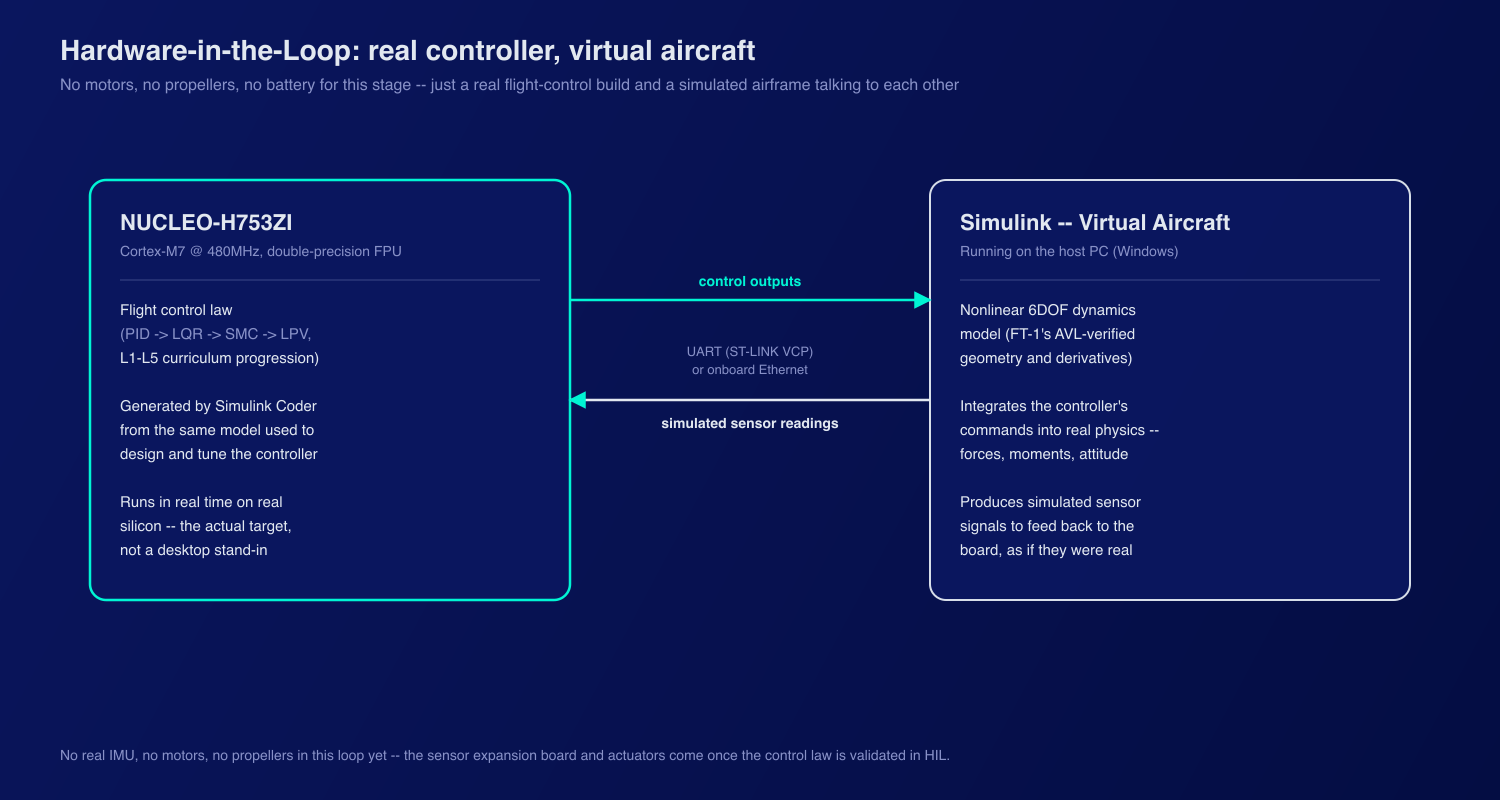
That framing matters for purchasing: a real IMU, real motors, and a real battery are all next-phase hardware, not this-phase hardware. The board’s job right now is just to run the actual control law — PID today, LQR/SMC/LPV as the curriculum progresses — while Simulink’s virtual aircraft plays the part of the physical world.
NUCLEO-H753ZI — and the board it replaced
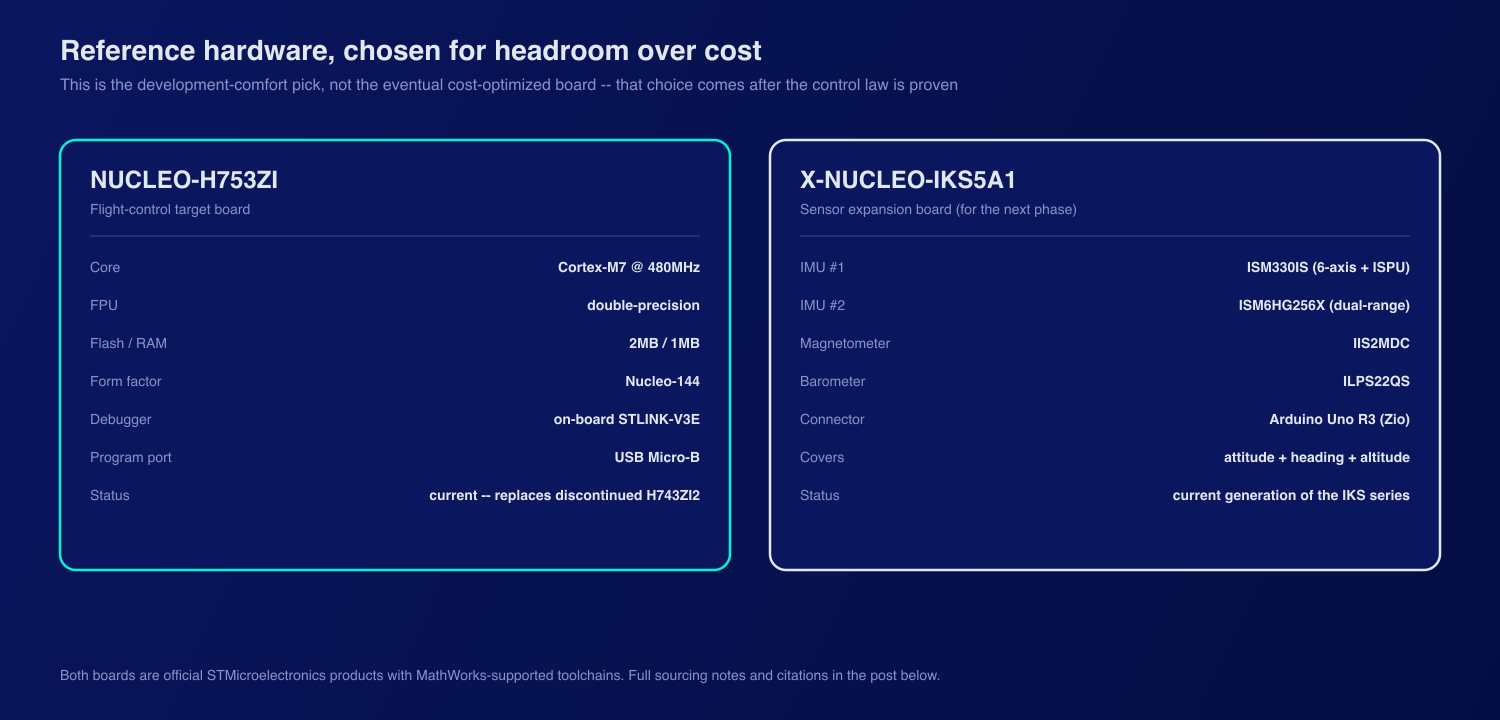
The first pick was NUCLEO-H743ZI2: Cortex-M7 at 480MHz, double-precision FPU, 2MB flash, 1MB RAM. Checking its current status turned up a real problem — it’s obsolete, no longer manufactured. STMicroelectronics’ own community forum confirms the recommended substitute is NUCLEO-H753ZI: identical performance, the only differences are onboard crypto/hash peripherals and a handful of relocated LED/QSPI pins. A project built for the H743ZI2 reportedly runs on the H753ZI with no code changes.
The double-precision FPU is the detail worth calling out: MATLAB and Simulink compute in double precision by default, so this board runs the exact numerical precision a model was designed in, with no downcasting during development. That heavily influenced the choice over a cheaper single-precision Cortex-M4 board (like the MathWorks-tutorial-standard NUCLEO-F401RE) — headroom now, cost-optimization later once the control law is proven.
X-NUCLEO-IKS5A1 — bought now, needed next
The sensor expansion board is the current generation of ST’s official Nucleo sensor shields: two IMUs (ISM330IS with an onboard ISPU for edge processing, and ISM6HG256X with dual-range acceleration sensing), a magnetometer, and a barometer — attitude, heading, and altitude sensing in one board that plugs straight into the Arduino-compatible header, no breadboard wiring required.
Worth stating plainly: it isn’t needed for the HIL milestone described above. A virtual aircraft’s “sensor readings” are numbers computed inside Simulink, not signals from a physical chip. This board earns its place once real sensor data — and its real noise — enters the loop, or when the project moves from a simulated airframe to a physical one. Buying it now was a headroom decision, not a requirement for the next thing actually being built.
One platform note worth flagging early
MathWorks’ current STM32 toolchain (the STM32 Microcontroller Blockset, shipping since R2026a) lists Windows and Linux as its only supported host platforms — macOS isn’t on the list. Anything involving Simulink-to-STM32 code generation and deployment has to happen from a Windows or Linux machine; simulation and controller design work can still happen anywhere.
References: STMicroelectronics NUCLEO-H753ZI product page and UM2407 user manual · STMicroelectronics community, “Nucleo-H743ZI2 NRND and use NUCLEO-H753ZI” · MathWorks STM32 Microcontroller Blockset platform requirements · STMicroelectronics X-NUCLEO-IKS5A1 product page and data brief.